MSCI EM지수 韓 비중 줄자
외국인, 어제 역대 최대 순매도
개인은 2.2兆 사들여 충격 줄여
증권가 "패시브 펀드 숨고르기
투자 환경 좋아져 외인 또 온다"
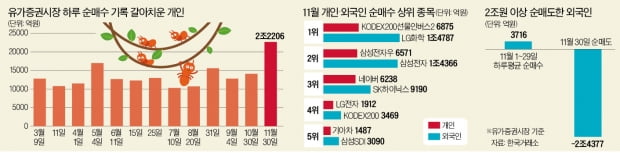
11월 마지막 날인 30일 증시는 또 다른 기록을 세웠다. 외국인은 유가증권시장에서 사상 최대인 2조4377억원어치를 순매도했다. 11월 하루 평균 수천억원어치를 순매수했던 외국인이 일순간에 돌변한 셈이다. 이 매물을 받아낸 것은 개인들이었다. 개인투자자들은 2조2000억원이 넘는 순매수를 기록했다. 개인 순매수도 사상 최대였다. 이날 코스피지수는 1.60% 하락한 2591.34에 거래를 마쳤다.
이날 외국인을 매도로 이끈 것은 MSCI 신흥시장(EM) 지수 개편이었다. 이 지수에서 한국 시장 비중이 줄자 기계적 매물이 쏟아졌다. 개인들은 추세적 하락이 아니라 극복 가능할 변수라고 판단, 대규모 매수에 나섰다는 분석이다.
개인의 힘
'증시는 많은 개미를 태우고 올라가지 않는다.' 증권업계 통설이다. 개인들이 매도한 뒤 주가가 오르는 게 그동안의 경험이었기 때문이다. 하지만 올해는 좀 다르다. 상반기 동학개미들이 올린 실적도 그렇고, 최근 움직임도 증권업계 통설을 반박하는 듯한 분위기다. 코스피가 2600선에 올라섰음에도 개인들이 매수에 집중하고 있다. 코스피 2400선에서는 차익실현 움직임을 보였던 개인들이 코스피 2600선에서는 다시 매수 주체로 변신했다. 그사이에 10년 코스피 박스권이 뚫릴 것이라는 믿음이 개인들 사이에서 커졌다는 게 증권업계의 분석이다.
개인은 이날도 유가증권시장에서 2조2206억원어치를 순매수했다. 외국인 순매도 물량 대부분을 받아냈다. 개인들은 코스피지수가 2600선까지 오른 지난 23일 8735억원어치를 순매도했다. 코스피가 1.92% 오른 것에 비해 매도 규모가 크지 않았다. 개인이 지난 5일 코스피가 2.40% 상승하면서 2400선에 올라섰을 때는 하루 만에 국내 주식시장에서 1조9707억원어치를 매도했기 때문이다. 개인은 2600선에서 추가 상승한 지난 24일에도 245억원어치를 내다파는 데 그쳤다. 이후 지난 25일부터는 3거래일 연속 순매수하며 총 9576억원어치를 사들였다. 코스피가 2600을 넘겼음에도 매수 전략을 취했다는 얘기다.
코로나19 사태 이후 개인들이 매수한 규모와 비교해도 11월 들어 개인의 매도세는 약한 편이다. 올 3~10월 개인은 국내 주식시장에서 총 49조7860억원어치를 순매수했다. 11월에는 2조1390억원어치를 매도하는 데 그쳤다. 전체 매수액 대비 5%도 안 되는 규모다. 증시 대기 자금도 늘었다. 금융투자협회에 따르면 투자자 예탁금은 지난 27일 기준 62조9567억원으로 10월 말(55조3452억원) 대비 13.7% 급증했다.
원인은 다양하다. 코로나19 백신 등장과 글로벌 경기 회복 기대감으로 코스피 우상향에 대한 기대가 커졌다. 단기적으로는 정부가 10억원이던 대주주 양도세 기준을 3억원으로 낮추려다가 철회한 것이 개인들의 연말 매수 부담을 줄였다. 정부의 부동산 규제 강화도 증시로의 자금 유입을 부추기는 요인이다.
MSCI에 움직인 외국인
외국인은 이날 유가증권시장에서 2조4377억원어치를 팔아치워 역대 최대 순매도를 기록했다. 지난 1~29일 하루 평균 3716억원어치를 순매수해 코스피지수 상승을 주도했지만 11월 마지막 날 돌변했다.
외국인이 유가증권시장에서 대량 순매도를 기록한 건 MSCI EM지수에서 한국 비중이 줄어든 것과 관련 있다. MSCI는 이날 지수 리밸런싱을 통해 한국 비중을 12.0%에서 11.7%(지난달 11일 시가총액 기준)로 줄였다. 쿠웨이트가 비중 0.2%(추정치)로 새로 편입됐고, 인도 비중이 8.3%에서 9.1%로 늘면서 한국은 상대적으로 축소된 것이다.
종목별 외국인 순매수 동향을 봐도 이런 관측에 힘이 실린다. 이번에 MSCI EM지수에 새로 편입된 종목은 SK바이오팜, SK케미칼, 두산중공업 등이다. 이날 외국인은 이들 종목을 각각 1258억원, 660억원, 441억원어치 순매수했다. 편출 종목인 BNK금융지주(-512억원), 포스코인터내셔널(-109억원) 등은 순매도했다.
코스피가 앞서 사상 최대치를 기록했던 2018년에 비해 한국 증시가 구조적으로 좋아졌기 때문에 외국인 자금 유입이 한참 더 남았다는 분석도 있다. 정연우 대신증권 리서치센터장은 “2018년 당시에는 증시가 반도체에 너무 의존했지만 지금은 2차전지, 바이오 등 다른 산업도 골고루 성장하며 투자 환경이 더 좋아졌다”며 “당시보다 금리가 낮은 것도 긍정적”이라고 말했다.
SINGAPORE - Customers can now choose from about 17,000 items on the iShopChangi platform, more than triple the number available before the coronavirus outbreak struck.
That is one of the ways Changi Airport Group (CAG) has moved to help retailers at the airport reach out to non-travellers in Singapore, as international travel remains at a standstill amid the pandemic.
CAG said online sales by Changi Airport retailers have surpassed pre-pandemic numbers, though it did not provide specific figures.
Said CAG spokesman Ivan Tan: "Currently, more than 90 per cent of our customers are non-travellers... Wines and spirits, beauty and electronics continue to be most popular with our customers."
The pivot to online sales comes with barely any travellers passing though the airport. Passenger traffic remains at less than 5 per cent of what it was before the pandemic, and retail sales at Changi Airport have plunged 74 per cent this year.
At Terminal 1 and Terminal 3, which have remained open, only about half of the outlets in the transit areas are operating. Operations at T4 have been suspended, while T2 remains closed after plans for upgrading works were brought forward.
Mr Tan said work has been done to transform Changi's food and beverage business through the launch of the Changi Eats food delivery service in June.
There are now 40 brands offering over 800 food, drink and snack items on the platform.
He said the number of orders received had grown almost fivefold since its launch, proving it was "plugging a market gap and demonstrating how we are value-adding to our customers".
Most recently, it launched shopping tours of its transit areas, held on weekends and by invitation only. They are targeted at customers who would otherwise have been travelling and shopping at Changi during the year-end holiday period.
Mr Tan said: "These shopping tours allow us to continue to engage our customers and share our deep knowledge of travel retail products with them."
WASHINGTON: The Trump administration is poised to add China's top chipmaker SMIC and national offshore oil and gas producer CNOOC to a blacklist of alleged Chinese military companies, according to a document and sources, curbing their access to US investors and escalating tensions with Beijing weeks before President-elect Joe Biden takes office.
Reuters reported earlier this month that the Department of Defense was planning to designate four more Chinese companies as owned or controlled by the Chinese military, bringing the number of Chinese companies affected to 35.
It was not immediately clear when the new tranche would be published in the Federal Register. But the list comprises China Construction Technology and China International Engineering Consulting Corp, in addition to Semiconductor Manufacturing International Corp (SMIC) and China National Offshore Oil Corp (CNOOC), according to the document and three sources.
The Defense Department did not respond to a request for comment.
The move, coupled with similar policies, is seen as seeking to cement outgoing Republican President Donald Trump's tough-on-China legacy and to box incoming Democrat Biden into hardline positions on Beijing amid bipartisan anti-China sentiment in Congress.
The list is also part of a broader effort by Washington to target what it sees as Beijing's efforts to enlist corporations to harness emerging civilian technologies for military purposes.
Reuters reported last week that the Trump administration is close to declaring that 89 Chinese aerospace and other companies have military ties, restricting them from buying a range of US goods and technology.
SMIC was already in Washington's crosshairs. In September, the US Commerce Department imposed restrictions on exports to the company after concluding there was an "unacceptable risk" that equipment supplied to it could be used for military purposes.
The list of "Communist Chinese Military Companies" was mandated by a 1999 law requiring the Pentagon to compile a catalogue of companies "owned or controlled" by the People's Liberation Army, but the Defense Department only complied in 2020. Giants like Hikvision, China Telecom and China Mobile were added earlier this year.
This month, the White House published an executive order, first reported by Reuters, that sought to give teeth to the list by prohibiting US investors from buying securities of the blacklisted companies from November 2021.
The directive is unlikely to deal the firms a serious blow, experts said, due to its limited scope, uncertainty about the stance of the Biden administration and already-scant holdings by US funds.
Still, combined with other measures, it deepens a rift between Washington and Beijing, already at loggerheads over the coronavirus and China's crackdown on Hong Kong.
Congress and the administration have sought increasingly to curb the US market access of Chinese companies that do not comply with rules faced by American rivals, even if that means antagonising Wall Street.